
Rheumatoid arthritis
What is rheumatoid arthritis?
Rheumatoid arthritis is a long-term condition that can cause pain, swelling and stiffness in your joints. The small joints in the hands and feet are often the first affected.
Key facts
|
A healthy joint
In a healthy joint, a coating of tough but smooth and slippery tissue, called cartilage, covers the surface of the bones and helps the bones to move freely against each other.
A joint affected by rheumatoid arthritis
With rheumatoid arthritis, when the inflammation in the joint goes down, the capsule around the synovium remains stretched and can cause the joint to become unstable.
What is rheumatoid arthritis?
Watch this video with other language subtitles
| Waa maxay xanuunka difaaca jirka ee saameeya kala-goysyada? | Somali subtitles |
| રૂમટોઈડ આર્થરાઈટિસ (Rheumatoid arthritis) એ શું છે? | Gujarati subtitles |
| முடக்கு வாதம் என்றால் என்ன? | Tamil subtitles |
| رہیموٹائیڈ آرتھرائیٹس (گٹھیا) کیا ہوتا ہے؟ | Urdu subtitles |
| Beth yw arthritis gwynegol? | Welsh subtitles |
What is rheumatoid arthritis?
Rheumatoid arthritis is also known as autoimmune arthritis because your immune system attacks healthy tissues in your body by mistake.
If it’s not treated, it can damage your joints, tissues and bones – and in some cases, your organs.
The outlook for people with rheumatoid arthritis is improving all the time, with new and more effective treatments. With the right treatment and support, many people can manage their symptoms, stay active and keep doing the things that matter to them.
What are rheumatoid arthritis symptoms?
The symptoms of rheumatoid arthritis often develop over weeks or months. But in some cases, they come on more quickly.
The main symptoms of rheumatoid arthritis are:
- pain in any of your joints
- joint swelling, warmth and redness
- stiffness, often first thing in the morning or after you’ve been sitting still for a while.
As well as joint problems, you may have other symptoms, such as:
- tiredness and lack of energy – this is known as fatigue
- not feeling hungry
- weight loss
- a fever
- sweating
- dry eyes
- chest pain.
Both sides of your body are usually affected at the same time, in the same way. But this is not always the case.
You may have periods where your symptoms come back or get worse, which is known as a flare-up.
Find out how you can keep moving with a flare-up, and why it can help.
How does rheumatoid arthritis affect the joints?
Inflammation is your body’s way of healing itself after an infection or injury. It boosts the flow of blood and fluid to an area, making it swollen, red, painful and hot.
But if you have rheumatoid arthritis, your body sends inflammation to your joints for no reason. This is not needed and can cause problems.
Your joints are held together by a fluid-filled capsule, which stops the bones from moving apart too far and protects them.
When the joint inflammation from rheumatoid arthritis goes down, the capsule can remain stretched. It can no longer hold the joint in its proper position, so it becomes less stable.
Find out more about how joints work.
Possible complications
If you have rheumatoid arthritis, you have a greater risk of developing some other conditions. The most common ones are listed below.
Carpal tunnel syndrome
Carpal tunnel syndrome is when a nerve in your wrist is compressed, often because of inflammation.
Symptoms include:
- aching
- numbness
- tingling in your thumb, fingers and part of the hand.
You’re likely to be able to control it using wrist splints, hand exercises and pain relief. But speak to your healthcare team if these methods are not helping.
Inflammation in other parts of your body
As well as your joints, rheumatoid arthritis can cause inflammation in other parts of your body, such as your heart, eyes, lungs and blood vessels.
You can reduce the risk of damage to your heart and blood vessels by:
- taking your medications
- eating a healthy, balanced diet
- keeping active
- stopping smoking.
Cervical myelopathy
Cervical myelopathy is caused by the joints at the top of your spine putting pressure on your spinal cord.
It needs to be treated, so if you notice any of these symptoms, tell your healthcare team:
- neck pain
- loss of balance
- trouble walking
- weakness or numbness in your limbs.
Joint damage
If your rheumatoid arthritis is not controlled, this could lead to joint damage.
Rheumatoid nodules
Around 1 in 5 people with rheumatoid arthritis develop fleshy lumps called rheumatoid nodules. They occur most in joints such as the hands, fingers, knuckles or elbows.
Some medicines reduce the chance of these nodules forming and treatments can help if you have them already.
Foot problems in rheumatoid arthritis
If you have rheumatoid arthritis, you’re more at risk of foot problems than other people. Getting into a good footcare routine can reduce this risk and allow you to spot any issues early on.
You might like to try:
- wearing footwear that supports your foot and fits well, which can help improve your balance and posture, to reduce strain on your joints
- getting your feet measured each time you shop for new footwear
- booking in to see a podiatrist – someone who specialises in treating foot problems.
Causes of rheumatoid arthritis
Rheumatoid arthritis affects around 450,000 people in the UK.
We do not know what causes it. But there are some factors that may make you more likely to develop it.
Rheumatoid arthritis risk factors
The rheumatoid arthritis risk factors that we know about are:
- most people are diagnosed at around the age of 50
- it’s much more common in women than in men
- it’s thought that genes may be a factor
- if you’re overweight, you have a greater chance of developing rheumatoid arthritis than if you’re a healthy weight
- people who smoke also have a greater risk of developing the condition.
Diagnosis
If your doctor thinks you may have rheumatoid arthritis, they will refer you to a specialist, who can arrange tests to confirm or rule out a diagnosis.
Rheumatoid arthritis is diagnosed based on:
- your symptoms
- an examination of you and your joints
- the results of X-rays, scans and blood tests.
Once you’ve been diagnosed, you will be seen at a rheumatology clinic in a hospital.
If you’re waiting for a diagnosis, there are plenty of ways you can manage your symptoms. To find out more, visit managing arthritis symptoms.
Treatment for rheumatoid arthritis
There’s no cure for rheumatoid arthritis yet, but treatments can help you feel better and prevent damage.
There are three main ways to treat rheumatoid arthritis:
- drugs
- physical therapies
- surgery.
Your healthcare team will measure how active your condition is using an assessment called the DAS28. DAS stands for ‘disease activity score’ and the number 28 refers to the 28 joints your healthcare professional will look at.
The score helps them see how your condition affects your body and how it’s responding to treatment.
Drugs
The drugs that are used to treat rheumatoid arthritis include:
- pain-relief medications
- non-steroidal anti-inflammatory drugs (NSAIDs)
- steroids
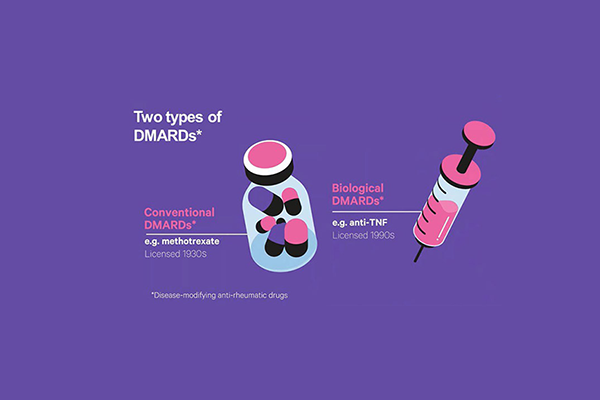
- disease-modifying anti-rheumatic drugs (DMARDs)
- biological treatments (bDMARDs)
- Janus kinase inhibitors (JAK inhibitors).
For more information, visit drugs A-Z.
Pain relief medicines and non-steroidal anti-inflammatory drugs (NSAIDs)
There are many types and strengths of pain relief and NSAIDs. Some, such as paracetamol and ibuprofen, can be bought from a pharmacy or supermarket. Others have to be prescribed by a doctor. NSAIDs are safe to take at the same time as pain relief.
Pain relief can lessen pain caused by rheumatoid arthritis. NSAIDs are used to relieve pain and reduce inflammation.
Neither of these types of medicines will stop rheumatoid arthritis from getting worse over time or causing damage to your body. So, they should not be the only type of treatment you receive.
Steroids
Steroids help to ease swelling, pain and stiffness. They provide short-term relief from symptoms, perhaps during a flare-up or while you’re waiting for a DMARD to start working.
Because of the possible side effects, they should be used for the shortest time needed to get your symptoms under control.
Disease-modifying anti-rheumatic drugs (DMARDs)
DMARDs change the way your condition progresses, rather than simply treating your symptoms. They reduce pain, swelling and stiffness by slowing down the condition’s effects on your joints.
You’ll need to keep taking them, even when you start to feel better, to keep your condition under control. And it can take a few weeks or months before you know whether they’re helping you.
Biological therapies (bDMARDs)
Biological therapies (sometimes called biologics) reduce the effects of parts of the immune system that attack the body’s healthy tissues.
They’re only offered to people who have tried other drugs and not responded well to them, in part because most of them have to be injected.
Janus kinase inhibitors (JAK inhibitors)
JAK inhibitors may be offered to you if other treatments have not worked.
They can cause severe side effects in people with certain risk factors or conditions, so they are not suitable for everyone.
Physiotherapy for rheumatoid arthritis
You might be offered physical therapies to ease your symptoms.
Physiotherapy involves movement, manual therapy, education and advice to help ease your pain and get your muscles and joints moving more easily.
A physiotherapist may also suggest hydrotherapy, which is a type of exercise that takes place in a warm water swimming pool, usually at a hospital.
Find out more about physiotherapy.
When is surgery required?
Not everyone needs surgery for rheumatoid arthritis, but it can help to reduce pain, correct the shape of a joint or improve your mobility.
There’s a type of keyhole surgery that’s used just for joint problems. A surgeon makes a very small cut so that they can repair damaged tissue, drain excess fluid and remove bits of loose bone or tissue.
Some people with rheumatoid arthritis might need surgery to replace part or all of a joint - most often the hip, knee or shoulder.
For more information, visit surgery.
Biologic drugs: Your questions answered
Research funded by Arthritis UK led to the development of a new class of drugs, known as biologics, which have transformed the treatment of inflammatory arthritis and improved the lives of almost 2 million people worldwide. In June 2021, biologics were approved for people with moderately active rheumatoid arthritis, enabling thousands more people to benefit from these treatments.
Living with rheumatoid arthritis
As well as any treatments, there are ways you can look after yourself to help you feel better. These include:
- physical activity and low impact exercise for rheumatoid arthritis
- eating well
- stopping smoking
- complementary treatments
- prioritising sleep
- accessing the help you’re entitled to at work
- looking after your mental health
- making use of aids and adaptations.
You can also call the Arthritis UK Helpline for free on 0800 5200 520. Our advisors can give you expert information and advice about your condition.
Pregnancy, fertility and breastfeeding
If your rheumatoid arthritis is under control, it should not affect whether you can get pregnant and have a baby.
If you’re about to start trying for a baby, your rheumatology team may advise you to stop taking your medication or change the treatment that you’re on. But you should never do this without speaking to a doctor.
Your healthcare team will refer you to a specialist who looks after pregnant people with rheumatoid arthritis.
But it’s not always possible to plan ahead. In this case, let your rheumatology team know as soon as you become pregnant. They can check that you and your baby are well – and make sure you’re on the right treatments.
There’s no reason why having rheumatoid arthritis should affect whether you can breastfeed. But some drugs should not be taken when breastfeeding.
For more information on pregnancy, fertility and breastfeeding, visit pregnancy, fertility and arthritis.
You can also go to the Best Use of Medicines in Pregnancy (Bumps) website to see which drugs are safe for use in pregnancy and while breastfeeding. This can help to inform your conversations with your healthcare team.

"It can be exhausting being a mum with rheumatoid arthritis. So, I think it’s important to accept help and make things easy for yourself."
Frequently asked questionsQ. Is rheumatoid arthritis hereditary? Q. Which is worse, osteoarthritis or rheumatoid arthritis? Q. What is the best pain relief for rheumatoid arthritis? Q. How is rheumatoid arthritis diagnosed? Q. Is rheumatoid arthritis an autoimmune disorder? Q. Does rheumatoid arthritis make you tired? |
Research and new developments
Our research has helped make breakthroughs and changed the lives of many people with rheumatoid arthritis. It has:
- led to the development of a new class of drugs, known as biologics, which have transformed the treatment of inflammatory arthritis
- shown that intensive treatment for inflammatory arthritis, started within 12 weeks of symptoms, increases the chances of remission as well as reducing pain and long-term joint damage.
We’re currently funding research projects to find out what causes rheumatoid arthritis, and to develop new and improved treatments.
- Our Centre for Genetics and Genomics Arthritis UK is trying to understand how genetic factors play a role in inflammatory arthritis.
- Our Research into Inflammatory Arthritis Centre Arthritis UK (RACE) is looking at why rheumatoid arthritis starts, why it attacks the joints, and why the inflammation carries on.
- Having shown that damage to the lining of the gut can play a role in the development of rheumatoid arthritis, our researchers at University College London will soon be looking to develop ways of controlling inflammation by restoring gut health.
Managing your symptoms
Pain can be a major symptom of arthritis. Find out about treatments, self-help and how to assess if your pain management is working.
How to manage arthritis painTips for managing stiffness, including therapies like wax bath therapy, hydrotherapy, and exercises for healthy joints.
How to manage stiff jointsIt’s common for arthritis to cause fatigue. Find out what fatigue is, what causes fatigue and how you can manage it.
How to cope with fatigueRelated information
-
The reality of living with rheumatoid arthritis – Matilda's story
Matilda was diagnosed with rheumatoid arthritis when she was 23, after experiencing symptoms for three years.
-
Rheumatoid arthritis booklet
Download our Rheumatoid arthritis information booklet as a PDF
-
Rheumatoid arthritis booklet (Welsh)
Download our Rheumatoid arthritis information booklet (Welsh)

You can trust our health information
Our information is PIF TICK certified. This means that it’s trusted, evidence-based and accessible.
Review date: July 2026
Next review: July 2029