

Our research strategy
Arthritis UK's research strategy guides our research investment to help adults, young people and children with arthritis live well today, while charting a path towards the cures of tomorrow.
Our research priorities and principles
Arthritis UK's research strategy is driven by the needs of people with arthritis. That’s why it focusses on research with the greatest potential to improve the quality of life – translational research. Research that turns observations in the laboratory, clinic and community into interventions that directly improve the health of people living with arthritis.
Our research aims to:
|
"Since 2022 we have been proud to invest in our four priority areas: early detection and prevention, targeted treatments, living well, and people and partnerships, addressing key unmet needs for people with arthritis."
Our research priorities
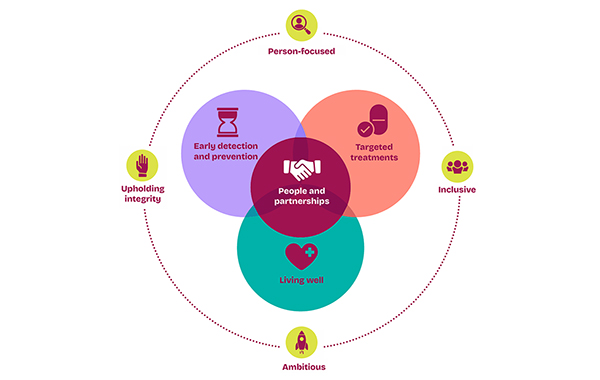
Our research strategy is a roadmap for delivering change in musculoskeletal research. It prioritises four areas where we will focus our investment and influence over the next four years:
 |
Early detection and prevention: |
Spotting the biological signatures of arthritis early to maximise the opportunities for timely intervention and preventing it from getting worse.
Our actions until 2028
- We will invest in research to understand the pre-disease pathophysiological mechanisms underlying symptom development and risk. This includes research using digital biomarkers and digital health tools/technology to enable early diagnosis and reduction of the impact of disease, including through prevention.
- We will invest in the development of reliable pre-symptomatic markers and diagnostic disease indicators and biomarkers to predict and detect arthritis at the earliest possible stage.
- We will advocate for the use of genetic risk scores as part of routine clinical management for arthritis conditions known to be genetically linked.
- We will invest in understanding the social and psychological factors and health inequalities that influence and/or predict disease development.
- We will promote accurate and consistent collection and use of diagnostic data across all healthcare settings. Where relevant, we will promote and invest in better linkage and harmonisation of existing datasets.
- We will work in partnership to support health service research, to learn how best to implement knowledge about early detection and diagnosis. We will actively engage with decision-makers to optimise their selection of evidence-based services.
 |
Targeted treatments: |
Taking the guesswork out of treatment by increasing effective, reliable and timely drug and non-drug solutions to reduce, manage or cure disease.
Our actions until 2028
- We will invest in ambitious precision medicine approaches, targeted treatments and personalised interventions that develop reliable ways to halt or reverse disease progression. This includes research that identifies specific groups of people with distinct mechanisms of disease, lived experience or particular response to treatments to understand when and in whom a treatment may or may not be effective.
- We will invest in research seeking to understand how diseases are linked, and where what is learned about one disease can be used to tackle other diseases.
- We will support research into disease agnostic pathways to understand common mechanisms of disease, particularly chronic inflammation, autoimmunity and immune-mediated inflammation.
- We will invest in the development of reliable, cost-effective psychotherapeutic and social intervention alternatives to drugs or surgery alone. This includes research on the impact of arthritis on mental health.
- We will invest in research that harnesses and utilises data tracked and gathered in digital health and tools from healthcare settings and patient reported outcome measures to better inform treatment development.
- We will work in partnership to support health service research, to learn how to create and implement large-scale holistic treatment, including for pain, fatigue, mental health and comorbidities.
 |
Living well: |
Addressing musculoskeletal health inequalities for individuals and wider society by striving for better musculoskeletal health and care at home, in leisure, at work and in communities.
Our actions until 2028
- We will invest in understanding the social and psychological factors influencing and predicting disease progression and outcomes. That understanding will inform how the different needs of different groups, including older people, people living with multiple long-term conditions, and children and young people, are met.
- We will invest in understanding how health services, local communities, and employers best work together to improve the lives of people with arthritis.
- We will invest in understanding the most effective ways to engage people with arthritis and local communities in different types of supported self-management, covering areas such as physical activity, mental health and social isolation. We’ll support research into how to increase the uptake of proven self-management interventions, particularly using digital health tools.
- We will advocate for the most effective ways to create meaningful and sustainable improvements in health services using health surveillance data. We will support initiatives learning how best to harness and bring together (existing) diverse sources of data, including health, social care and other national sources and data from people tracking their own health outcomes.
- We will share research-driven solutions with people with arthritis, and relevant services and professionals, in ways that help people with arthritis to manage their condition.
 |
People and partnerships: |
Making Arthritis UK the partner of choice – for our funding partners, the life-sciences industry and our researchers.
Our actions until 2028
People
- We will focus our investment on building the capacity and numbers of researchers in mid-career stages, providing fellowship support for excellent intermediate researchers who are committed to working in the field of arthritis research and are seeking to establish themselves as independent researchers.
- We will explore how to help our current and future researchers enhance their careers, by looking at where to build on our existing mentoring networks and relationships.
- With the help of our research advisory/clinical study groups, we will continuously review the skills gaps in arthritis research to better address the distinct needs across the UK nations. Where necessary, we will create opportunities for skills-sharing and collaboration in a targeted manner.
- We will examine the needs of researchers and industry, and enhance our patient and public involvement and engagement support to researchers. We will incentivise co-production right from the outset of any research project, as appropriate for the area of research.
Partnerships
- We will engage in increased and more efficient partnership management, with greater emphasis on building and participating in (funding) consortia to increase the scale of investment and impact for people with arthritis.
- To deploy our resources efficiently in areas where we cannot achieve the desired scale or profile alone – such as multiple long-term conditions, rare diseases, health service capacity and collective immune-mediated inflammatory conditions – we will work in partnership.
- Where possible, we will prioritise data harmonisation and linkage, ideally in partnership with other funders, instead of investing in competing long-term projects and infrastructure initiatives.
- We will aim to increase the likelihood of clinical and commercial success of our funded and future portfolio with more innovative models of collaboration and involvement of commercial partners.
"We are proud to leverage the power of partnership with Arthritis UK and deliver on our common goal to address the ongoing huge unmet needs of people living with arthritis."
Better lives today, better lives tomorrow
Research strategy 2022-2028
Arthritis UK's research strategy focusses on research with the greatest potential to improve quality of life for people living with arthritis. Research that turns observations in the laboratory, clinic and community into treatments and approaches that positively impact the health of people worldwide.
Our research principles
Person-focused
We ensure people with arthritis are active partners across our whole research cycle and consistently feel valued, through a culture of co-design. We invest in solutions tailored to individuals, not a disease.
Inclusive
We ensure people with arthritis from a diverse range of backgrounds, cultures and experiences are partners and participants in our research activities and those of our collaborators. We represent the full life-course of the population through our research. We promote diversity, equity and inclusivity across our researcher community.
Ambitious
We are committed to finding effective treatments and cures through need-inspired, excellence-driven, innovative and impactful research delivered at an increased pace.
Upholding integrity
We provide honesty, rigour, transparency, as well as care and respect for those involved in our research – both researchers and the people benefitting from it – and accountability for our role in creating a positive research environment.
"Whilst we refreshed our look and name in 2025, our vision and mission are still the same. That means we remain committed to funding life-changing research that benefits people with arthritis."
Find out more about the research we fund
If you would like to find out about the research funding we have allocated, you can browse our current research projects and use our handy A-Z tool to search by the first letter of a condition to discover condition-related projects.
Evaluating our impact
We want groundbreaking solutions to spot and stop arthritis in its tracks. We want to offer people with arthritis choice and control, so they can live fulfilling lives. The long-term changes we want to see stretch beyond the duration of this research strategy, but they have informed our short-term activities until 2028. Continuously monitoring and evaluating the impact of these activities will ensure we continue to demonstrate the difference that our investment is making and are accountable to our supporters.
We will establish priority area-specific success metrics that our organisational committees and groups will check on an annual cycle, ensuring we are achieving our targets in line with our research principles. This will guide adjustments in our operational planning and strategic decision-making.
We know that research has longer-term impact, far beyond the ‘end date’ of the funded research award. We also know that those impacts can be diverse and we will ensure we innovate and adjust our monitoring to capture the true impact and diversity of our investment. We will further invest in disseminating and showcasing the wider impact, reach and potential of our research.
We play an active role in monitoring the performance of our research and supporting its delivery. We will align with the San Francisco Declaration on Research Assessment, assessing research outputs through a range of impact measures. These will go beyond academic impact alone (academic publications, journal metrics) to include the qualitative contribution to science and society, influencing policy and practice.
Arthritis UK research
-
Our research achievements
Our research has helped us to make life-changing breakthroughs and improve the lives of millions of people living with arthritis.
-
Our research centres
Our research centres and their partnerships across the UK bring together musculoskeletal experts who deliver significant results.
-
Live research projects
Use our handy A to Z tool to explore which live research projects Arthritis UK is currently funding. Browse by the first letter of a condition for details of the related research project.