
How joints work
What is a joint?
A joint is where two or more bones meet, such as in the fingers, knees, and shoulders. Joints hold our bones in place and allow them to move freely within limits. Our joints are designed to allow the bones to move in certain directions and or to rotate.
The knee is the largest joint in the body and one of the most complicated. It must be strong enough to take our weight and must lock into position, so we can stand upright. But it also has to act as a hinge, so we can walk, and needs to twist and turn when we run or play sports.
Anatomy of a joint
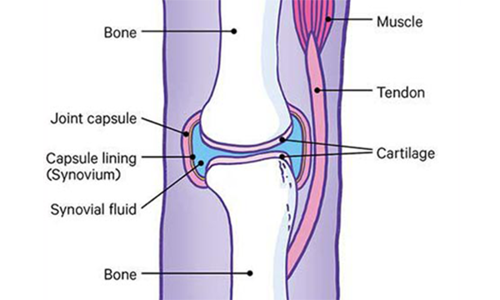
- Cartilage: The end of each bone in a joint is covered with cartilage that has a very smooth, slippery surface. The cartilage allows the ends of the bones to glide over one another as you move, almost without rubbing.
- Synovium: The joint is held in place by the synovium, which contains thick fluid to protect the bones and joint. The synovium has a tough outer layer that holds the joint in place and stops the bones moving too far.
- Tendons: Strong cords called tendons anchor the muscles to the bones.
- Joint capsule: Most of the joints in our body are surrounded by a strong capsule. The capsule is filled with a thick fluid that helps to lubricate the joint. These capsules hold our bones in place.
- Ligaments: Capsules hold our bones in place with the help of ligaments. These are a bit like very strong elastic bands.
If we want to move a bone, our brain gives a signal to the muscle, which then pulls a tendon, and this is attached to the bone. Muscles therefore have an important role in supporting a joint.
A healthy joint
In a healthy joint, a coating of tough but smooth and slippery tissue, called cartilage, covers the surface of the bones and helps the bones to move freely against each other.
How does osteoarthritis affect a joint?
When a joint develops osteoarthritis, part of the cartilage thins and the surface becomes rougher. This means the joint doesn’t move as smoothly as it should.
When cartilage becomes worn or damaged, all the tissues within the joint become more active than normal as the body tries to repair the damage. The repair processes may change the structure of the joint, but will often allow the joint to work normally and without any pain and stiffness. Almost all of us will develop osteoarthritis in some of our joints as we get older, though we may not even be aware of it.
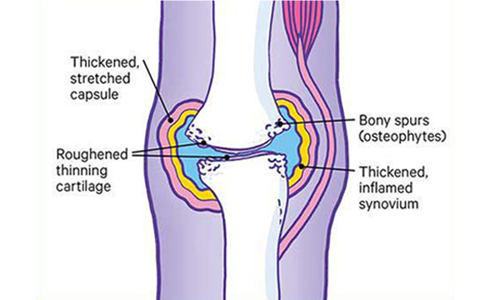
However, the repair processes don’t always work so well and changes to the joint structure can sometimes cause or contribute to symptoms such as pain, swelling or difficulty in moving the joint normally.
For example:
- Extra bone may form at the edge of the joint. These bony growths are called osteophytes and can sometimes restrict movement or rub against other tissues. In some joints, especially the finger joints, these may be visible as firm, knobbly swellings.
- The lining of the joint capsule (called the synovium) may thicken and produce more fluid than normal, causing the joint to swell.
- Tissues that surround the joint and help to support it may stretch so that after a time the joint becomes less stable.
How does rheumatoid arthritis affect a joint?
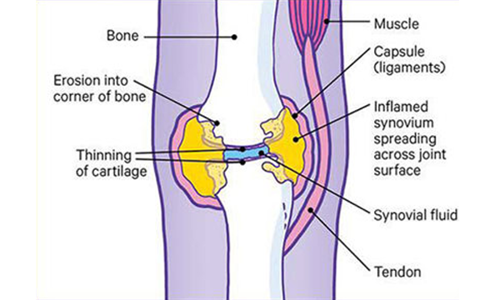
In rheumatoid arthritis, the immune system can cause inflammation inside a joint or a number of joints. Inflammation is normally an important part of how your immune system works. It allows the body to send extra fluid and blood to a part of the body under attack from an infection. For example, if you have a cut that gets infected, the skin around it can become swollen and a different colour.
However, in the case of rheumatoid arthritis, this inflammation in the joint is unnecessary and causes problems.
When the inflammation goes down, the capsule around the synovium remains stretched and can’t hold the joint in its proper position. This can cause the joint to become unstable and move into unusual positions.
How do joints become damaged?
If you have arthritis, your muscles may weaken over time, causing the joint to become unstable. Your bones and cartilage may become damaged, and eventually your joints may change shape.
If you have an inflammatory type of arthritis that causes pain, swelling and stiffness in your joints, such as rheumatoid arthritis, your ligaments supporting the joint capsule can be stretched due to repeated joint swelling.
Joint care is particularly important for people with arthritis because it can:
Joint care: Looking after your joints when you have arthritis
When you’re dealing with joint pain, everyday tasks such as getting in and out of the shower, getting dressed or making the bed can feel like a struggle. However, you can reduce the pain and strain on your joints by changing the way you do things. This is called joint protection or joint care.
Gout: Your questions answered
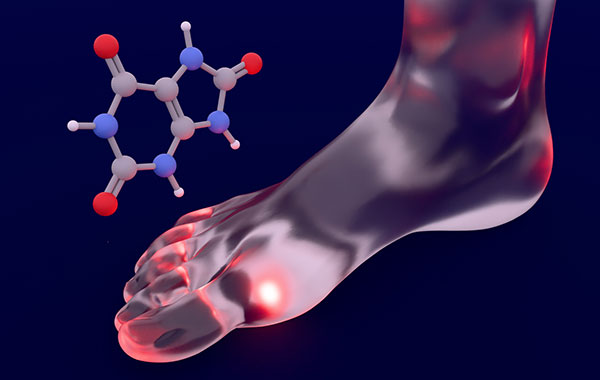
Gout is a painful form of arthritis caused by uric acid crystals that form in and around the joints. It’s the most common type of inflammatory arthritis. It’s more common in men and you’re more likely to get it as you get older. Find out what causes gout and how you can treat it.

Joint hypermobility: What it means
Hypermobility means you can move some or all your joints more than most people can. It is thought that hypermobility affects one in five people. Although for many people it doesn't cause problems, hypermobility can cause some people pain, fatigue, and injuries to joints and ligaments.
Find out more about
-
Exercises for healthy joints
Exercises for your neck, shoulders, knees, back, hips, feet, ankles, toes, wrists and fingers to keep your joints healthy.
-
Conditions
What types of arthritis are there? Explore our comprehensive directory covering the 7 types of arthritis and related musculoskeletal disorders.
-
Joint care
Arthritis can damage joints and cause them to change shape. Find out about joint protection and how you can reduce the strain on your joints.