
Patient involvement in arthritis research
What is Patient Involvement?
Patient involvement refers to a person living with arthritis, or their partner, family member or carer acting as active partners and leaders in research activities.
Patient involvement can take many forms, such as co-producing patient information booklets, facilitating project workshops and contributing to project presentations, all of which are valuable at different stages of your project. Good practice is to 'do with' and work in partnership. For example, asking people to review plans or communications, is important, but better still, you might work jointly and produce shared plans and objectives from the outset.
What difference does involvement really make to research projects, outcomes and people with arthritis?
Feel more motivated and focussed on what's important to people with arthritis and my role in improving this. I have built skills in things like communication and facilitation, with confidence to do more PPI.
Feel more confident, listened to, empowered and better connected to my peers and health professionals. I have learnt about arthritis and new skills- this has been a part of self management journey
Projects are more relevant, better designed, and more acceptable to participants. Funding is given and the research makes real world change This PPI practice is adopted by others.
Arthritis UK involvement expectations
We support the UK Standards for Public involvement and the EULAR recommendations for involvement in rheumatology research, and expect that these will be adhered to throughout research projects. Working in partnership with people who have lived experience of arthritis we have developed our Arthritis UK Good Practice Guidelines for Involvement to share our expectations with our colleagues, health professionals and researchers. Take a look at our page that collates and summarises the standards, recommendations and guidelines.
We led a group of health research funders in developing a common Patient and Public Involvement reporting question set for researchers in the ResearchFish (owned by Elsevier) platform. You can read more about our involvement reporting.
What could involvement in research look like in your work?
If you are new to involving people with arthritis in your research, find out how to get started.
The people involved in your research should be reflective of the people your research aims to impact. Find advice, support and resources to help with achieving this.
Research involvement should happen at every stage of the research cycle, in all types of research projects, including lab-based research.
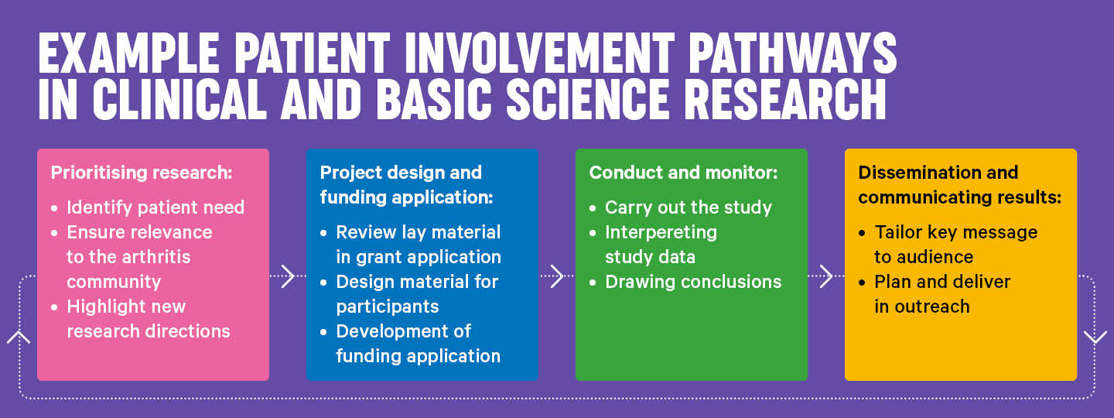
| Research type | Basic research | Clinical research |
| Context | Professor Smith is a researcher at the Austin institute studying biomarkers for the early diagnosis of osteoarthritis. | Dr Brown is a clinician at the Chesterfield Royal Hospital and wants to study the effect of different orthotics on the gait of patients with total ankle replacements (TARs). |
| Prioritising research | Professor Smith invites a patient group to a meeting to discuss his research group's library of biomarkers and they help choose several which have the possibility to confer patient benefit | Dr Brown contacts TAR patients via hospital clinics to ask if they are interested in forming a user research group, to discuss the advantages and limitations of current ankle orthotics. |
| Project design and funding application | Professor Smith writes a grant to Arthritis UK based upon the patient feedback. Prior to submission, the application is distributed to the patient group for feedback. | Prior to undertaking the study, Dr Brown needs ethical approval. The patients review the ethics application and advise on changes. |
| Conduct and monitor | The grant application is accepted and the research undertaken. The patients reviewed the data and advise on conclusions. |
The patient panel design and review the experimental protocol and patient information leaflets for the study |
| Dissemination and communicating results | A PhD student in the Smith group is presenting the data at an international conference. They practice their presentation in front of the patient panel and ask for feedback. |
Members of the patient panel co-present the results at orthopaedic conference. |
Fundamentals of PPIE
-
Checklist for planning your involvement
Developing an involvement plan before you begin will maximise the benefit of your activities and ensure that they are suitable and accessible for people with arthritis.
-
Involvement In Research Planning Template For Researchers
This document aims to support you to plan and consider how to involve people with arthritis in your research project or programme.
-
Costing for PPIE
This page gives an understanding of the elements that researchers need to consider when adding up costs for PPIE work. It includes things to think about such as venue hire, training, and payment for involved people.
-
Diversity and inclusion of PPIE groups
Resources to help guide you to make your PPIE more diverse and inclusive. Things to remember when involving people from all backgrounds with arthritis. Age, accessibility, ethnicity, frameworks.
-
Communicating in lay language
Learn how to engage diverse audiences with clear accessible language and compelling narratives.
Involvement resources
You can look at tips and resources to involve people at each stage of your study through our research cycle pages below.
Explore more information on the research cycle