
Disease-modifying anti-rheumatic drugs (DMARDs)
What are DMARDs?
Disease-modifying anti-rheumatic drugs (DMARDs) can treat the underlying cause of your condition and reduce inflammation. They're given to people with autoimmune conditions, such as rheumatoid arthritis, psoriatic arthritis and lupus. These are conditions where the immune system, which normally fights infection, attacks the body’s own healthy tissues.
DMARDs can improve symptoms such as pain, stiffness and swelling, but they may take a few weeks or even months to fully take effect.
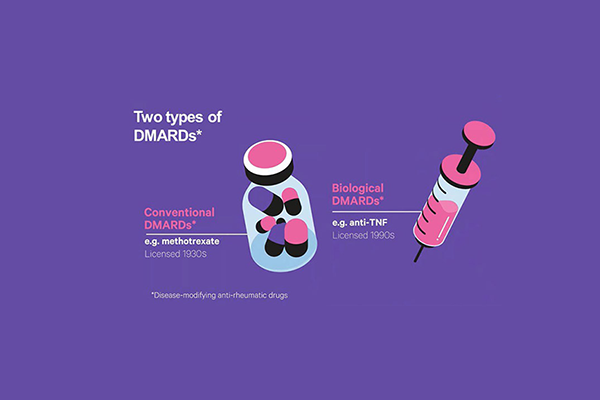
There are different types of DMARDs, and they work in slightly different ways. The three main types are:
- conventional synthetic DMARDs, including methotrexate
- biological therapies, like adalimumab
- targeted synthetic DMARDs, such as the JAK inhibitors baricitinib and tofacitinib.
Conventional DMARDs
This group of drugs are slow-acting and can take several weeks to work, so it's important to keep taking them even if they don't seem to have any effect at first. If you don't respond well to one of these drugs, or if you develop any side-effects, then your doctor may try one of the others.
Read more about the following conventional DMARDs:

Methotrexate: Your questions answered
Methotrexate is a type of disease-modifying anti-rheumatic drug (DMARD) often prescribed for treating arthritis. It’s used to reduce activity of the immune system in people who have certain types of arthritis and related conditions.
Biological therapies
Biological therapies are a relatively new class of medicines. They stop or block particular cells in the immune system from triggering inflammation, and so target the underlying cause of diseases. They tend to work more quickly than conventional DMARDs.
Some biological therapies are called anti-TNF drugs. They target a protein called tumour necrosis factor, which increases inflammation when excess amounts are present in the blood or joints. Other biological therapies target different proteins.
Biological therapies are only given to people who have already tried other treatments appropriate to their condition and not responded well to them. Biological therapies are often given in combination with a conventional DMARD such as methotrexate.
Read more about the following biological therapies:
Read more about the following anti-TNF drugs:
Biologic drugs: Your questions answered
Research funded by Arthritis UK led to the development of a new class of drugs, known as biologics, which have transformed the treatment of inflammatory arthritis and improved the lives of almost 2 million people worldwide. In June 2021, biologics were approved for people with moderately active rheumatoid arthritis, enabling thousands more people to benefit from these treatments.
JAK inhibitors
JAK inhibitors are a class of drugs that work by blocking the action of Janus kinase enzymes, which are involved in the inflammation that causes the symptoms of rheumatoid arthritis and psoriatic arthritis.
Read more about the following JAK inhibitors:

Joint care: Looking after your joints when you have arthritis
When you’re dealing with joint pain, everyday tasks such as getting in and out of the shower, getting dressed or making the bed can feel like a struggle. However, you can reduce the pain and strain on your joints by changing the way you do things. This is called joint protection or joint care.
Arthritis treatments
-
Drugs
Learn about arthritis drugs, what they're prescribed for, how to take them, who should take them, risks and side-effects.
-
Therapies
Learn more about how hydrotherapy, occupational therapy and physiotherapy can help relieve arthritis symptoms and pain.
-
Surgery
Learn more about the surgery options for people with arthritis, how it can help and what the recovery process involves.
-
Complementary and alternative treatments
Learn about complementary and alternative treatments for arthritis, how they might help, safety and possible risks.