
Cooking with arthritis
Tips for cooking with arthritis
Chopping, stirring, or even holding utensils can be challenging if you have stiff and painful joints. But with a few adjustments, it's possible to make your kitchen work better for you and cooking with arthritis easier.
Here, people living with arthritis share their tips on making cooking more enjoyable and manageable.
Batch cooking
If you want to save a bit of time and money, batch cooking is a good place to start. Batch cooking, or cooking in bulk, simply means cooking more than you need, so you can store and eat it later. And it can be a helpful strategy for days when you have a bit more energy.
“The most important thing I do is batch cool. On a Sunday, I'll make four lunches for the whole week. Then for the rest of the week, I don't have to worry about having to cook something from scratch every day.”
Use your freezer
To prevent food waste and make your groceries stretch further, you could try freezing meals too.
“If I’m making dinner, I’ll make portions for the next 2-3 days and I’ll freeze a load. Then I’ve got a portion that I can defrost whenever I need it,” says Emily, 30, who lives with inflammatory arthritis.
Buy pre-chopped or prepared food
Fruit and vegetables are a mainstay of any healthy, balanced diet. But we know that chopping, slicing, and cutting food can be tough if you have sore hands or poor grip.
If this is something you find challenging, why not make things easier for yourself and opt for pre-chopped or prepared foods?
You can find many of these in the frozen aisle of your supermarket and they’re often cheaper. Best of all, frozen fruit and vegetables can have just as many (or sometimes more) nutrients as fresh!
You could also try using microwavable rice pouches, prepared salads, or other pre-made meals. Don’t be afraid of the odd processed or pre-packaged food too. It’s about finding what works for you.
Lighter pots and pans
Holding heavy items like pans, saucepans, or kettles can be tough when you have sore, achy arms. So, it might be worth swapping to lightweight alternatives if you can.
Christine, 75, who lives with osteoarthritis says: “I’ve ditched my heavy kettle because of my wrist. I’m never sure if my wrist is going to give out.”
Pace yourself
Pacing yourself is all about listening to your body and taking breaks if you need them.
By reducing discomfort and fatigue, it might allow you to enjoy the cooking process without overexerting yourself.
“Do it at your own pace,” says Emily, 30, who lives with inflammatory arthritis. “Let’s say I’m making a butternut squash salad that has quite a few steps. I’ll peel and chop the vegetables in the morning and in the evening, I’ll roast them.”
If you find it difficult to stand for long stretches, don’t hesitate to sit down too.
75-year-old Christine has osteoarthritis in her hip, knee, neck, lower spine, hands and wrists.
She says: “I spend a lot of time alone, and arthritis can be very limiting. I like cooking, but standing in the kitchen for any length of time is very difficult. I have to do something and sit down for a bit and repeat.”
Reorganise your kitchen
Stretching for hard-to-reach cupboards can be challenging. So, make sure common items are handy and accessible.
If you’re moving home, it’s also worth considering the layout of your kitchen.
Jack, 36, lives with psoriatic arthritis and says in his last kitchen, “the cupboards were really high up.”
“I’m not short but I would have to use a step ladder to access the very top ones, which — if your arthritis leaves you a bit wobbly — isn’t very good.”
That’s why he was thankful when he saw that the cupboards in his new home were much lower.
Make grocery shopping easier
Find grocery shopping exhausting? Nowadays, most supermarkets offer online shopping. So, you can get your groceries delivered to your home at the click of a button.
Ask for help
Remember you don’t have to do everything on your own. Maybe a friend or family member could help cook dinner or do the grocery shopping?
Cooking can be a joyful experience, and having an extra set of hands might make it a bit easier for you. Plus, it’s a fantastic way to spend quality time with loved ones.
Simple recipes
Mealtimes don’t have to be complicated. Why not choose recipes that need minimal chopping, stirring, or other tiresome techniques? One-pot meals, sheet pan dinners, and slow cooker meals can be fantastic ways to simplify mealtimes. So, it’s worth knowing a few recipes offhand.
Don’t overlook your microwave too. There are many foods that you can quickly prepare in the microwave, rather than on the hob. For example, you could quickly microwave your veggies to help save a bit of time and energy.
Healthy recipes for arthritis
Cooking a wholesome meal can be a great way to look after ourselves, unwind after a long day, or show a loved one we care. But we know that for some people living with arthritis, the thought of preparing meals can be a little daunting and cooking can be a tiring when you live with a long-term condition or disability.
That is why we are bringing you delicious recipes that are easy to make as well as helpful tips and advice in the kitchen.
Our recipes have been specially created for people with musculoskeletal (MSK) conditions who want to cook well at home by Ian Taverner, The Cooking Coach.
In this video, Ian shows how to make his healthy lemon and blueberry bites that are not only nutritious but are also so easy to make.
Healthy lemon and blueberry bites
Difficult rating: 1 2 3 4 5
Makes: 12
Preparation time: 15 mins
Cooking time: 0 mins
Allow yourself: 30 mins
For this recipe, you will need:
- zest and juice of half a lemon
- 3/4 cup rolled oats
- 3/4 cup walnuts
- 1/2 cup dates
- 1/4 cup blueberries (fresh or dried)
- a splash of maple syrup for sweetness.
Method
Easy to measure by cup, the rolled oats and the walnuts are twice the amount of the dates and the blueberries. You could use dried blueberries if you don't have fresh. Blitz the ingredients in a little hand blender, a food processor, smoothie maker to as rough or a smooth consistency as you like. Then simply shape the blended mixture into balls. Pop them into the fridge to firm up. You can also freeze them if you make a large batch. You can switch out any of the ingredients and add in different fruits if you prefer.
Healthy lemon and blueberry bites
Healthy bean and green stew
Difficulty rating 1 2 3 4 5
Makes for: 4-6 people
Cooking time: 40 mins
Preparation time: 20 mins
Allow yourself: 70 mins
For this recipe, you will need:
- 1 tablespoon olive oil
- 1 cup frozen chopped onion
- 1 tsp garlic puree
- 1 tsp chilli paste
- 1 tsp ginger paste
- 1 tsp ground coriander
- 1 tsp ground cumin
- 1 tbsp tomato puree
- 2 fresh thyme leaves (or 1 tsp dried)
- 1 can chopped tomatoes
- 2 cans mixed beans drained
- 600ml vegetable stock
- a large handful of spinach
- a large handful of kale
- pinch salt and pepper to taste.
Method
First, fry the onion on a medium heat for about 5 minutes until soft, then add the garlic paste, chilli paste and ginger paste and stir. Add the ground coriander and ground cumin, the tomato puree and the can of chopped tomatoes. Next. add the mixed beans, pour in the vegetable stock. Add the spinach and kale and simmer for 15 minutes. Serve with crusty bread, pasta or brown rice for a delicious and nutritious supper.
Healthy bean and green stew
Need some more recipe inspiration? Our quarterly magazine, Inspire, is packed with tasty recipes to help you get started. It’s also full of features, news, tips and information on how to live well with arthritis and related conditions.
Use aids and adaptations
If you’re struggling to cook, it might be worth seeing if there are any gadgets or equipment that could help make things a little easier. These are sometimes called aids and adaptations.
For example, maybe it'd be easier to enjoy your meal if you used adaptive cutlery. These are knives, forks, or spoons that are specially designed to make them easier to use. So, they might have thicker, softer grips, for example.
Aids are equipment that help you manage everyday tasks, such as cooking. They include items such as:
- Two-handed saucepans.
- Kettle tippers.
- Cutlery with large handles.
- Electric tin openers.
- Nonslip kitchen cutters.
Adaptations are changes or additions to your home. For example, adding lever taps to your kitchen sink.
Most lever taps only need a quarter turn to turn the tap on and off. So, they can be helpful if you have poor grip.
Aids and adaptations can be expensive. But you may be eligible to get aids and minor adaptations worth less than £1,000 for free from your local council. This is sometimes called ‘community equipment.’
To check if you’re eligible, simply ask your council for a free needs assessment.
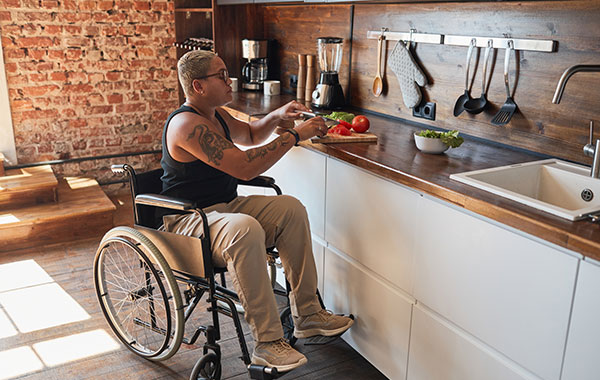
Aids and adaptations that make cooking with arthritis easier
Top tips for cooking, preparing food and coping in your kitchen as well as around the house when you are living with arthritis or a musculoskeletal condition.
Food and arthritis: your questions answered
-
Are there any foods that help with arthritis?
Research has shown that following a Mediterranean style diet is helpful for people with some types of arthritis and there are certain foods that are thought to reduce inflammation.
-
Do any foods make arthritis worse?
Do any foods make arthritis worse? We examine the research.
-
What is a balanced diet?
Important for your general health, a balanced diet involves eating a range of foods in the right amounts to stay healthy and maintain a good weight.

Get Inspire magazine delivered to your door for just £3 a month
Created specially for people living with arthritis, every edition of Inspire magazine is packed with expert, in-depth articles, recipes and features, covering what matters most to you — all for just £3 a month.