
Under the Radar? – How to avoid missing RAIRDs
Rare autoimmune rheumatic diseases (RAIRDs) are collectively not that rare – enclosed are some diagnostic tips
Article kindly written by Dr Peter Glennon, recently retired GP, currently GP Board member of RAIRDA.
RAIRDs include Sjögren’s disease, lupus, systemic sclerosis, inflammatory myopathies, and various types of systemic vasculitis. A primary care health care professional will usually only see a handful of these in a clinical lifetime, some of them never. Most of these diseases have a musculoskeletal component, but they may also present with a wide range of systemic, vague and disparate symptoms and signs spread out over time. Consequently, they all tend to have long diagnostic odysseys of several years despite being serious, chronic, multisystemic and even life-threatening conditions.
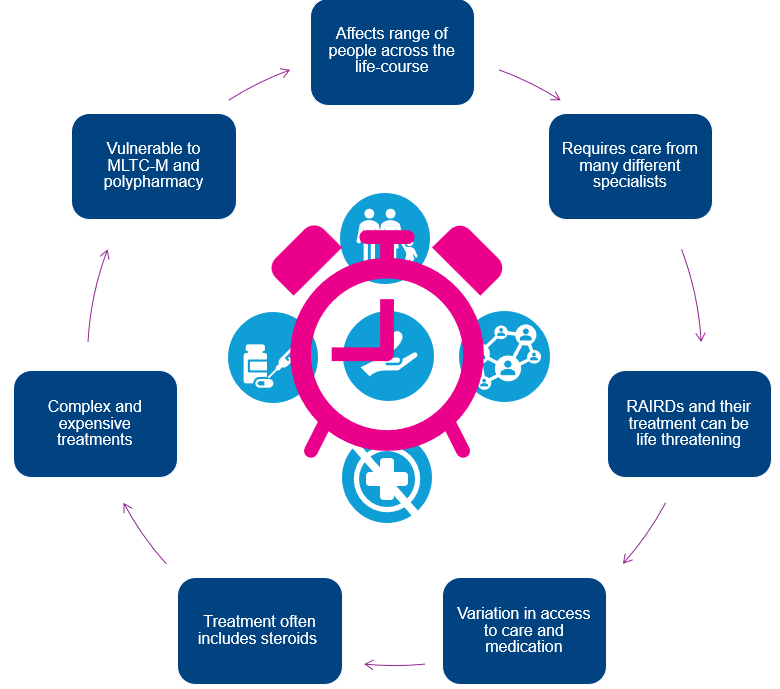
A primary care practitioner cannot be expected to remember their complex diagnostic criteria but fortunately there are significant commonalities and actual overlaps between many of the RAIRDs. The purpose of this article is to provide some “generic” diagnostic tips that may improve earlier and appropriate triage to secondary care (often rheumatology, but also renal and respiratory medicine) to reduce the damage done by delayed, missed or wrong diagnoses.
Patients with RAIRDs can become sick very quickly. Be vigilant for this and act quickly to prevent serious morbidity and mortality. Targeted treatment regimens are transforming the treatment of the RAIRDs making earlier diagnosis and management even more crucial.
Diagram kindly produced by Dr Rosemary J Hollick, Director, Aberdeen Centre for Arthritis and Musculoskeletal Health | University of Aberdeen; Honorary Consultant Rheumatologist | NHS Grampian; Clinical Lead, Scottish Systemic Vasculitis Managed Clinical Network | National Services Scotland
Ten RAIRD diagnostic tips for the primary care community
- MEDIUM RARE - RAIRDs are collectively not that rare. For example, Sjögren’s disease is estimated to affect up to 3% of women over 55 – be wary of odd clinical patterns and “Dare to think RAIRD”.
- COMMONALITIES - RAIRDs may overlap with each other (for example Sjögren’s disease, lupus, systemic sclerosis, mixed connective tissue disease (and rheumatoid, although, this is not classed as a RAIRD). Remember that some of these are characterised by inflammatory arthralgia in the absence of overt clinical arthritis.
- TEST ADVICE - Current blood tests for RAIRDs have significant false positives and false negatives. This can be minimised by using immunology testing wisely to help confirm a clinical suspicion rather than as a “fishing expedition”. Remember that CRP and ESR are not necessarily interchangeable – they are different measures of inflammation – CRP is often normal in lupus and Sjögren’s disease, for example, whereas ESR will usually be elevated. The ESR will often be normal in systemic sclerosis. ANA is especially prone to false positives (with increasing age, for example) but is still a gateway test for many of the RAIRDs – most labs will go on to do further appropriate CTD screening given a good history and an adequate titre of ANA positivity. The recent expansion of the advice and guidance pathway is a useful route for dealing with equivocal results. It is also worth considering a possible RAIRD with otherwise unexplained cytopenias.
- EXPLORE FATIGUE - About 10% of primary care consultations are for fatigue. Fatigue is also a prominent presenting feature in many of the RAIRDs. Primary care history-taking skills are paramount here in discriminating “inflammatory” from “noninflammatory” fatigue and exploring the patient’s own ideas, concerns and expectations. “Clinical instinct” utilising transference and countertransference can also be invaluable. Fatigue is not a “tick box” exercise.
- MENTAL HEALTH - Physicians consistently underestimate the level of psychiatric morbidity in RAIRD patients. This is mainly in the form of anxiety, depression and insomnia but can also include psychosis and seizures in the case of lupus (where CNS antibodies are implicated). Be vigilant for mental health presentations that are atypical or have other features suggestive of a possible RAIRD. It is also worth being mindful of the demographic, symptomatic, and actual, overlap between Fibromyalgia syndrome and Sjögren’s disease. “Fibrofog-type” symptoms are not the preserve of fibromyalgia and are also seen in Sjögren’s and Lupus, for example. There is a danger of overlooking an evolving RAIRD if a fibromyalgia label has been already given (so called cognitive anchoring).
- SJÖGREN’S THUMBNAIL - In patients presenting with fatigue and sicca (dry eyes/dry mouth) think possible Sjögren’s disease, although these symptoms are common in the general population. Exclude drugs with a high anticholinergic burden (ACB) as a cause, for example, some antidepressants, bladder stabilisers, antihistamines. Will often have high ESR, cytopenias, positive ANA and anti-Ro antibodies. Over 90% will be women.
- LUPUS THUMBNAIL – Exclude lupus in patients presenting with a butterfly rash, photosensitivity, serositis, alopecia, neuropsychiatric symptoms. ANA is nearly always positive and may have anti dsDNA antibodies. Checking BP and dipping urine for blood and protein is simple, but vital, in all suspected RAIRD patients.
- SYSTEMIC SCLEROSIS THUMBNAIL – Can be so called limited type (equivalent to older “CREST” type) or diffuse. High risk of renal crisis early in diffuse type. Think of this with new onset Raynaud’s over age 30, with puffy hands and fingers (if you have a dermoscope look for abnormal nailfold capillaries – compare with your own for a baseline). ESR may be normal, but ANA is nearly always positive.
- ANCA ASSOCIATED VASCULITIS (AAV) THUMBNAIL – Rare, easily missed, but needs urgent discussion. Think of AAV in cases of acute kidney injury (AKI) with no obvious extrinsic cause, especially if co-existing lung problems such as haemoptysis, late onset asthma, and interstitial lung disease (ILD). Also think of AAV with persistent nasal septal issues, recurrent sinusitis, mononeuritis multiplex. Dip urine for blood and protein – NICE recommend urgent discussion with nephrology within 24 hours if AKI with no clear cause and possibility of vasculitis.
- IDIOPATHIC INFLAMMATORY MYOSITIS (IIM) THUMBNAIL – Painless proximal muscle weakness, often very high creatine kinase, rashes with dermatomyositis, can be paraneoplastic. ANA usually positive.
Finally, the genetics and epigenetics of the RAIRDs are complex but a positive family history increases risk. Females are 10-20 times more likely to suffer from lupus and Sjogren’s disease. Other autoimmune diseases such as those affecting the thyroid and coeliac diseases are significantly more common in RAIRD patients. Interstitial lung disease (ILD) is also significantly more common in most of the RAIRDs and may precede diagnosis. There is little doubt that the RAIRDs are challenging and complex, even for secondary care; they don’t easily fit into a set of primary care guidelines. These tips have been formulated by the GP author from multiple sources including over 100 pages of recent BSR guidelines. If you have found these useful, a more detailed, but still primary care focussed account of “how to diagnose a RAIRD in primary care” can be found by scanning the following QR code (free access to RCGP members or via Athens) https://doi.org/10.1177/17557380261442943.
The views expressed in this article are those of the author and not necessarily that of the organisation although all content has been checked against clinical guidelines and the evidence base available. Before implementing any advice in practice, readers are advised to seek independent advice for their own specific circumstances.