
How we track research impact
What do we mean by research impact?
For us, research impact simply means:
- the changes brought about by research, and
- the benefits these changes bring for people with arthritis and other musculoskeletal conditions.
Ultimately, we see impact as the benefit our research brings to people with arthritis. We also know this can take time, often many years. When it happens, it can be difficult to measure the benefit and directly attribute it to specific research projects. For this reason, we focus first on the changes occurring over time. This is the basis of what we ask researchers to report. We usually refer to changes as outcomes.
How do we measure research impact?
Small changes can more easily attributed to research and can be more easily tracked over time. We track changes in relation to seven different areas:
- New knowledge
- Influence on policy and practice
- New networks
- Leveraged funding
- Increased capacity to conduct research
- Patient and public involvement
- New intellectual property, products and services.
We call these our impact areas.
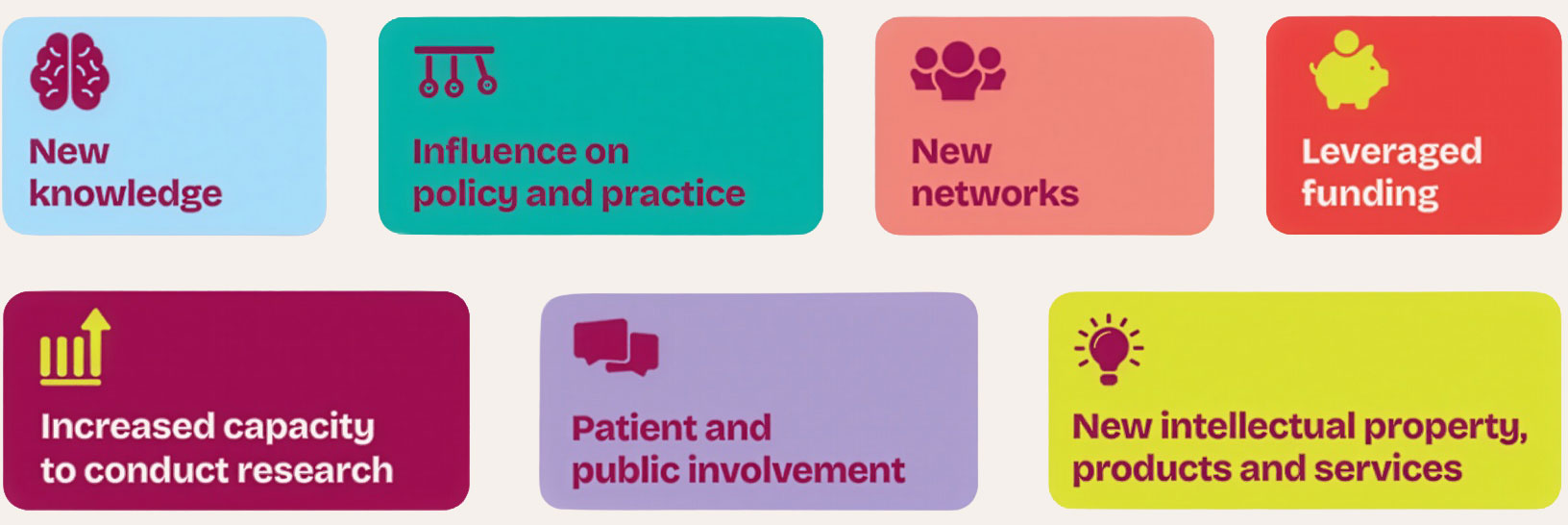
All our award reporting questions relate to these impact areas, for example, a new research publication would relate to new knowledge. An individual element may not be significant at first, but they help to build a picture of change over time. They may develop from one impact area to another, e.g. from new knowledge into a new product, or policy change. This assists us in articulating how our funding helped bring about more substantial changes and, ultimately, benefits for people with arthritis. In effect we are building a map of data which tracks incremental changes over time.
The table below sets out examples of the types of changes we might expect to see over time, noting that research outputs are more frequently reported, but that changes can develop from these.
| Category | Outputs | Preliminary changes | Small-scale changes | Large-scale changes |
| New knowledge | Publications | Citations | Research is developed further by others | New ways of thinking are adopted at large scale |
| Leveraged funding | Partner contributions from project outset | Additional funding leveraged after project outset | Larger-scale funding expanding project scope | Larger-scale funding for scale up, transformation or new project |
| Policy and practice | Research shared with policymakers | Citation in policy / equivalent | Policy or practice change at regional / local level | Policy or practice change at national / large-scale level |
| Capacity building | Training delivery, new resources | Researcher training in practice, new tech | Researcher career progression, growth of team | Growth in national field of arthritis research |
| Products and IP | Product being developed, TRL2 | Product or service pilot, TRL3/4 | Product being used / trialled locally / regionally | Product being used at national level / large scale |
| Networks and partnerships | Novel partnerships within award | Partnership growth into new awards. Broadening networks | Development of regional, multi-disciplinary partnerships | Development of large-scale, multi-disciplinary partnerships |
| PPI | People with arthritis (PwA) involved in research | PwA are embedded with the project team | PwA contribute to outcomes and are benefiting | Approaches to involving PwA have been adopted by others |
Our impact areas are deliberately agnostic to the type or stage of research or arthritis condition. This makes it as relevant for a PhD student studying inflammatory arthritis biomarkers as it is for research understanding health inequalities at population level.
Applications and reporting
Our funding calls sometimes direct applicants to specific impact areas in which we are seeking change from our funding, such as policy change or new networks. We request that applicants to these awards pay close attention to these and clearly define the changes, often referred to as outcomes, they expect from their work, and how they will be achieved. Successful applicants should anticipate that reporting will focus on progress towards these changes (outcomes) both during the award and after the award has finished.
We understand that impact can also appear in unexpected ways. For this reason, our reporting requirements will always remain open to capturing outputs and changes from the full range of impact areas, including those not directly targeted by the funding.
Find out how to
-
Reporting your research progress and impact
Find information about our reporting requirements and tools including Researchfish, Europe PMC (EPMC) and Grant Tracker.
-
Tell us about your publications
Are you advancing arthritis research? Notify Arthritis UK of your upcoming publications and maximise your impact.