
Prioritising Musculoskeletal Healthcare in Northern Ireland
From Breaking Point to Recovery: Prioritising Musculoskeletal Healthcare in Northern Ireland
Arthritis UK has published a landmark report calling for immediate action to tackle the growing musculoskeletal (MSK) health crisis in Northern Ireland.
Over half a million people in Northern Ireland are living with arthritis or another MSK condition, with devastating impacts on quality of life, employment, education and mental health.
Examine the report's key findings and our calls to action.
Download the report
From Breaking Point to Recovery
Introduction
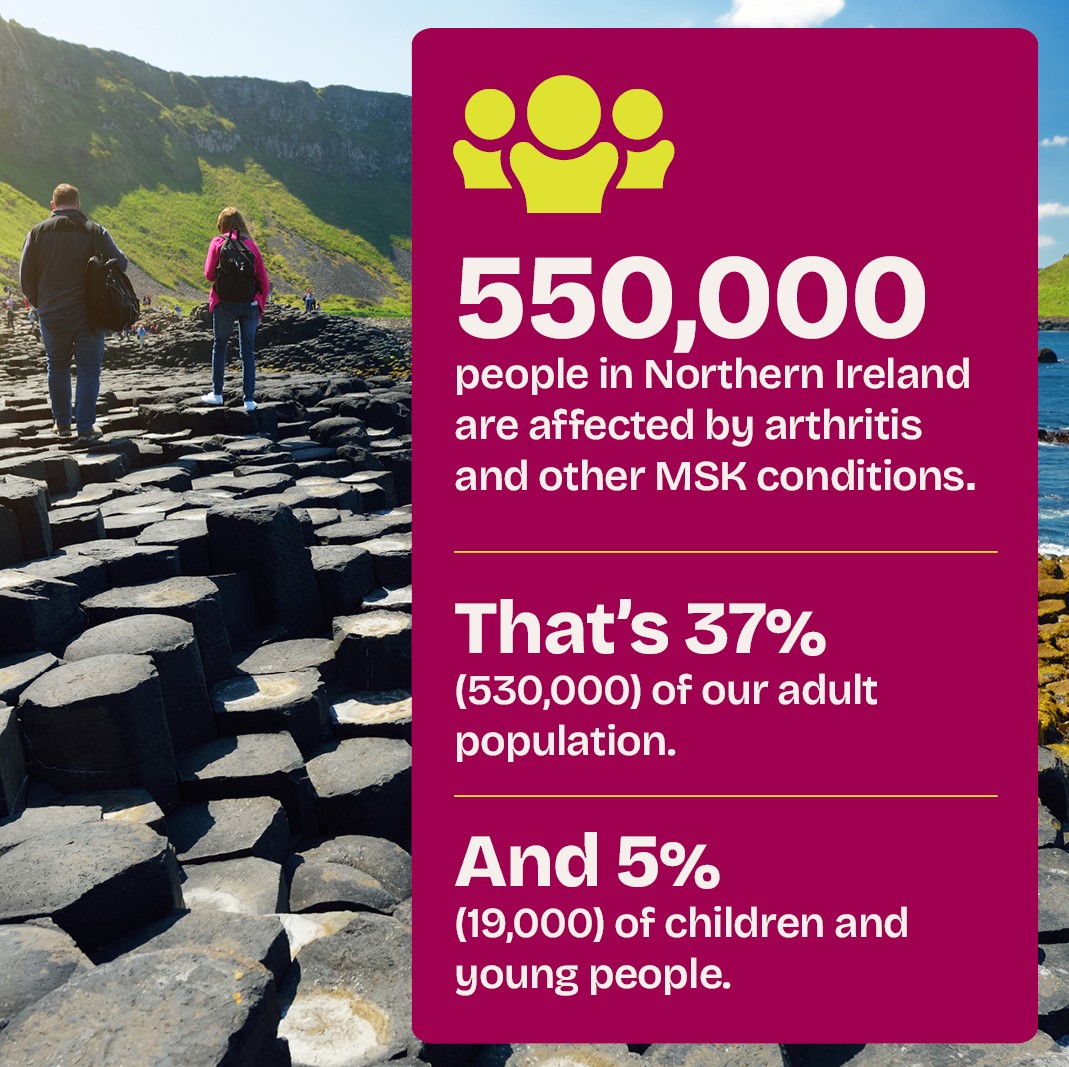
Arthritis and other MSK conditions affect millions of people across the UK, including 550,000 people in Northern Ireland. That is 37% (530,000) of our adult population, and 5% (19,000) of children and young people.
The impact of these conditions combined with unacceptably long waits for diagnosis and treatment come at an enormous personal cost to those living with the condition, as well as at a cost to the health service, the economy and wider society. A survey into the lived experiences of people with arthritis and MSK conditions (conducted by YouGov on behalf of Arthritis UK in 2024 showed that in Northern Ireland:
- 79% of people live in pain most or all the time.
- 67% say arthritis has impacted their ability to work.
- 43% have stopped working altogether.
- 76% report that waiting for treatment has harmed their mental health.
What’s more, our recently published ‘State of Musculoskeletal Health 2025’ report highlights that:
- People with arthritis are 20% less likely to be in work than someone without the condition.
- MSK conditions are the 3rd-most-common reason for working days lost, only behind ‘Other’ (including COVID-19) and ‘Minor Illnesses’.
- 43% of people with an MSK condition are economically inactive.
"When you’re diagnosed at a young age, you lose your independence and friendships because you cannot go out and do ‘fun things’ as normal."
The lengthy waiting times for treatment in Northern Ireland are increasing disease progression and co-morbidities such as poor mental health. For example, depression is four times more common among people who have persistent pain. Plus, people with osteoarthritis (OA) have a 61% increased risk of diabetes and a 24% higher risk of cardiovascular disease.
These figures point to the serious impact of arthritis on individuals and society. And with MSK conditions accounting for at least one in seven GP consultations, there is a strategic need part of Northern Ireland’s future health agenda.
In this context, Arthritis UK commissioned an independent research exercise (led by Blueprint Development Consultancy) that would provide insight into the current MSK landscape in Northern Ireland, to understand what’s working well and what needs improvement across primary, secondary and community care.
"I face frustration and anger from patients who simply want to know what is happening and when. Meeting a patient who has been waiting for years and whose health has been deteriorating is very dispiriting."
Prioritising MSK healthcare in Northern Ireland
Informed by this engagement, the following report sets out four clear calls to action to improve MSK healthcare in Northern Ireland.
The focus is ‘systemic’ change, sitting largely with the Department of Health (DoH). However, many clinical responses also pointed to improved ways of working within Trusts, which, with support from management, could positively impact patient flow and waiting times. These clinical specifics are beyond the scope of this report, except to highlight the need for a cultural shift within healthcare to challenge embedded hierarchy and bureaucracy and empower service improvement at all levels.
Overall, clinicians were generous, both with their time and openness to working differently to bring about change. The term ‘moral injury’ was mentioned frequently, along with the burden and frustration of watching patients deteriorate while on waiting lists.
‘Frustration’ was the term used most frequently by both patients and clinicians; however, this also came with an appetite for change.
The following actions bring clarity and focus on how to deliver that change, detailing what is needed and achievable within Northern Ireland in a relatively short timeframe.
Calls to action
Our report sets out four urgent calls to action to improve MSK healthcare in Northern Ireland:
- Establish a strategic approach to MSK healthcare. Introduce MSK leadership within the Department of Health and create a coordinated policy framework.
- Improve care pathways and diagnosis. Enhance general practitioner (GP) training, streamline referrals, address transition to adult services for young people and integrate mental health support.
- Transform waiting times, patient support and communication. Tackle waiting lists, improve communication and support while waiting.
- Increase public awareness of MSK health and patient education. Launch public health campaigns and empower patients to manage their condition.
"A regional MSK network would be helpful, allowing equalisation within Trusts and across waiting times and sharing expertise on what is working well."
Call to action 1: Establish a strategic approach
to MSK healthcare
What needs to happen
- DoH to introduce MSK strategic leadership and policy coordination. Given the scale and impact of arthritis, and the views of clinicians, we believe there is a need for a Clinical Lead role within the Department to have oversight of MSK healthcare policy and planning across the health system. This would bring the necessary focus to prioritise MSK care and treatment, delivering service efficiencies, reduced waiting times, and standardised care pathways that improve patient outcomes.
- Arthritis UK in Northern Ireland to establish a Strategic Advisory Group for MSK Health. In the current absence of policy coordination for MSK health as a whole, Arthritis UK in Northern Ireland to establish a Strategic Advisory Group for MSK Health in collaboration with DoH policy leads, SPPG (Strategic Planning and Performance Group) and clinical leads.
- DoH to undertake a policy review to drive reform within rheumatology in Northern Ireland.
Call to action 2: Improve care pathways and diagnosis
What needs to happen
- In collaboration with clinical leads, DoH to ensure consistent patient pathways for treating OA and inflammatory arthritis through effective diagnosing, triaging and referral.
- DoH to increase GP and medical students’ education and training in diagnosing and treating arthritis and other MSK conditions. Arthritis UK to support with specialist advice, training and information, such as its ‘MSK Core Skills’ training and British Society for Rheumatology-accredited short courses.
- DoH to improve the pathway for young people transitioning to adult services through long-term transition planning including exploring the potential of:
- An introductory clinic between paediatric patients and clinicians in adult services.
- A specialist support pathway for young people to support transition from teens to adults with resourced staffing support from adult and paediatric teams.
- Mental health services should be an integral part of the care pathway for MSK conditions, so that patients have access to mental health support throughout their treatment journey as needed. HCPs should also look to Arthritis UK to help support patients with managing their MSK condition, which will in turn support their mental health.
Call to action 3: Transform waiting times, patient support and communication
What needs to happen
- DoH to implement its ‘Support While Waiting’ policy and sustain ongoing investment in ‘waiting well’ initiatives to ensure a positive step change in patient experience and support.
- DoH to ensure continued ringfenced funding to increase orthopaedic capacity and drive down waiting times.
- DoH to ensure Trusts regularly and effectively communicate with patients on waiting lists utilising examples of best practice in other devolved nations. Better communication should include:
- A single point of contact who can answer patient queries and help with their concerns.
- Regular updates about when people will have their surgery or first consultant appointment, and the care and services they should expect in the meantime, including signposting to relevant statutory, community and voluntary support.
- DoH working cross-departmentally (particularly with the Department for Communities) to ensure patients are signposted to benefits and employment support/advice to help them find or stay in work if they choose.
Call to action 4: Increase public awareness of MSK health and patient education
What needs to happen
- DoH, SPPG and the Public Health Agency (PHA) to recognise arthritis as a major public health issue and instigate a public awareness campaign to highlight the reality of the condition and what proactive steps people can take to look after their MSK health from an early age.
- DoH and Trusts should involve voluntary organisations, such as Arthritis UK, in providing expert health information, patient education and patient-centred innovation in secondary care through the use of hubs, mega clinics and community appointment days.
"There is vicarious trauma being experienced by clinicians as they see the suffering their patients have on a daily basis, and from working within a dysfunctional system that increases suffering for everyone, most of all patients and their families/carers."
Conclusion
Having listened to people with lived experience, clinicians and senior decision makers it is clear that change is desperately needed and needed now; this report presents four calls to action to urgently prioritise and transform the MSK health of people in Northern Ireland.
The waiting lists demonstrate that we are already beyond crisis point. The scale of arthritis and MSK conditions within Northern Ireland is undeniable, and the burden on the individual, our healthcare services and society weighs heavily.
Short-term funding and interim fixes cannot bring about the transformation required. Instead, in the context of well-publicised budgetary pressures within the Northern Ireland health system, sustainable and affordable change must be implemented.
This was reflected in the responses of those who contributed to this report. While bringing different experiences and expertise, they identified common ground in terms of themes, priorities and possible solutions. All gave freely of their time, reflecting a desire to change the current landscape and a commitment to wanting to deliver better solutions.
Our four calls to action focus on improved methods of working across the DoH, community, primary and secondary care settings, in addition to encouraging the public to take an active approach to managing their health.
The emphasis is deliberately on strategic change and ways of working, as opposed to funding demands. That being said, we are in danger of lurching from crisis to crisis without sustained investment.
We believe this report can be a catalyst to put in place actions that are achievable within the next five years, making a real difference to patients and clinicians.
Methodology
Our research was informed by an advisory group of members drawn from the Department of Health and MSK clinicians working across primary, secondary and community care including orthopaedic surgery, rheumatology, general practice, physiotherapy, podiatry and specialist nursing.
The project involved direct engagement and consultation with:
- Those living with MSK conditions.
- Health and care professionals (HCPs) working in the field.
- Senior officials in the Department of Health.
Desk research was also conducted, informing the strategic and policy context within Northern Ireland and the other UK Nations.
To seek the views of a cross section of those living with MSK conditions, Arthritis UK brought together a number of patient focus groups across the five Health and Social Care Trusts (Trusts). Over a 3-month period between June and August 2025, 10 focus group discussions were undertaken involving 80 participants. These were largely in-person and facilitated by members of the Blueprint team (supported by Arthritis UK staff), using a semi-structured questionnaire.
Engagement with clinicians and key policy and decision makers was done using one-to-one interviews (22 in total). In parallel, the engagement process was informed by a detailed questionnaire completed by 130 HCPs including GPs, allied health professionals (AHPs), orthopaedic specialists, rheumatologists and specialist nurses.
Related information
-
The State of Musculoskeletal Health
The State of Musculoskeletal Health is a collection of the most up-to-date, UK-wide statistics on arthritis and other MSK conditions.
-
Left Waiting, Left Behind: The Reality of Living with Arthritis report
Based on a survey of almost 8,000 people's lived experience, this report presents in-depth insights into the personal and financial cost of living with arthritis and policy recommendations.