
FAQs: Beyond BMI briefing
FAQs
What is the problem?
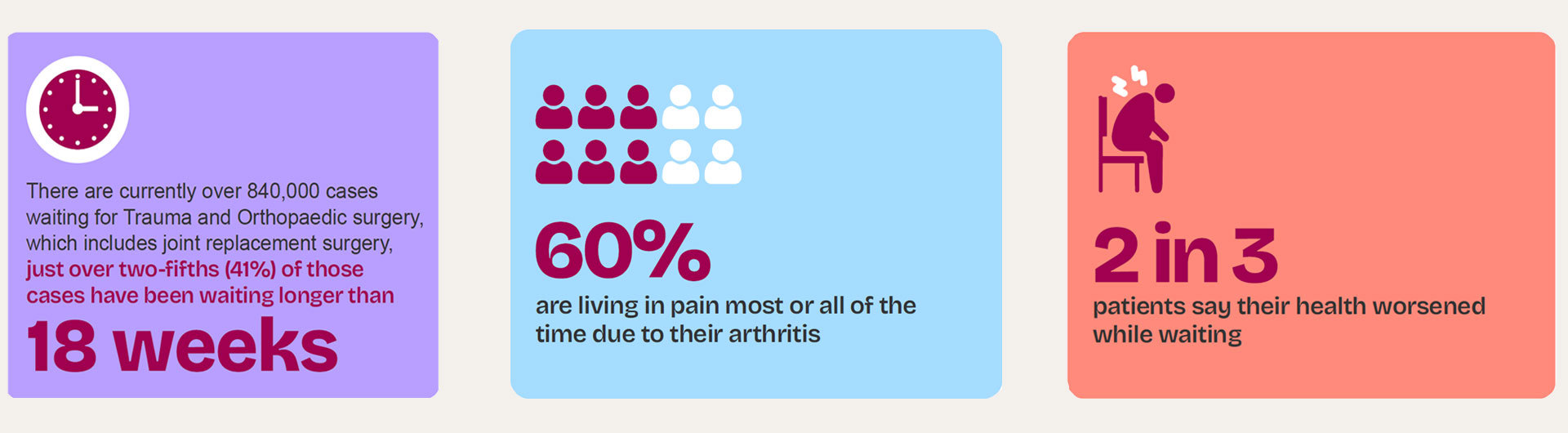
Some Integrated Care Boards across England are using body mass index (BMI) scores to restrict access to joint replacement surgery. Access to joint replacement surgery should be determined by clinical need, and not due to a person’s body weight. The use of BMI thresholds to determine access to treatment is not grounded in evidence and goes against national clinical guidelines and the position of the UK government. These policies have significant detrimental impact on those they are enforced upon, they force people with arthritis to wait longer for treatment, leaving them in pain and unable to live the lives they want to.
So, what should happen?
Patients should be screened to identify any potential surgical risks, at the earliest possible point in their pathway (for example, at the point of referral from primary care), to identify potential surgical risks, allow for pre-surgical health optimisation, and to avoid unnecessary delay to treatment.
Following a personalised screening assessment, if a surgical risk is identified, patients must be informed of the benefits, risks, alternatives and likely outcomes of surgery. Then through shared decision making, patients can make an informed decision to proceed with surgery, undertake health optimisation, pursue alternative treatments including conservative management, or seek a second opinion.
Ultimately, it is the patient's decision, including the decision to have no treatment whatsoever. If, through shared decision making, health optimisation is agreed prior to surgery, then patients should receive proactive, personalised and holistic support to improve their health prior to surgery, including prompt access to weight management support.
What is Arthritis UK calling for?
Arthritis UK is calling on Integrated Care Boards across England to stop using BMI threshold policies to delay or deny access to joint replacement surgery. Access to treatment should be based on clinical need and not decided exclusively by a person's BMI.
What is Arthritis UK doing to change these policies?
The Beyond BMI briefing is intended to highlight the use of these policies and add to the growing literature around their use. We intend to use this briefing to inform conversations with Members of Parliament, representatives from Integrated Care Boards, and engaging with other organisations to draw attention to this issue.
What is Body Mass Index (BMI)?
Body Mass Index (BMI) is a tool used to assess whether a person’s weight falls within an underweight, healthy, overweight or obese range. BMI is calculated by dividing an adult’s weight in kilograms by their height in meters squared. There are four key ranges for BMI that are as follows.
- Underweight: 18.4 or below
- Healthy weight: between 18.5 to 24.9
- Overweight: between 25 to 29.9
- Obese: between 30 to 39.9
Adjustments to BMI categories are made to the for those from Asian, Chinese, Middle Eastern, Black African or African-Caribbean family backgrounds by adjusting the categories by -2.5kg/m2. For example, the overweight range starts at 23kg/m2 and the obese range starting at 27.5kg/m2.
You can find out more information at: BMI – What you need to know - PIF TICK
Measures of weight and health derived from BMI are unreliable, BMI alone can underestimate and overestimate body fat accumulation due to failure to account for muscle mass, aging, gender, or ethnicity. BMI is unable to distinguish between muscle and fat distribution; it is a poor indicator of body composition and is not considered as a reliable measurement. Therefore, considerations of suitability for surgery should be ascertained through assessing a combination of factors inclusive of, but not solely based on, measures of BMI.
What is an Integrated Care Board?
In England, Integrated Care Boards (ICBs) are organisations that are responsible for planning how NHS services will be delivered to best meet local needs. They manage the NHS budget and work with local providers of NHS services, such as hospitals and GP practices.
There are currently 42 Integrated Care Boards in England, however, in April 2026 some ICBs will merge. These mergers aim to allow ICBs to operate more cost-effectively over a larger area.
What are weight management service Tiers?
The classifications of weight management services in England are referred to as Tiers 1-4.
- Tier 1: universal prevention services, these are typically public health or primary care activities such as health promotion or provision of information regarding overweight or obesity.
- Tier 2: behavioural overweight and obesity management services; these include lifestyle or behavioural interventions to support people in changing dietary behaviours and increasing physical activity. These services are often time-limited (typically 12-weeks) community-based interventions funded by local authorities, sometimes delivered by commercial companies (e.g. Slimming World).
- Tier 3: specialist clinician-led multidisciplinary interventions designed to support individuals who have not responded to conventional weight management interventions and who are at high risk of, or have already developed, obesity-related complications. These are NHS commissioned services that include dietitians, psychological support and weight-loss medications.
- Tier 4: surgical interventions, such as bariatric surgery.
In England, ICBs oversee Tier 3 and 4 weight management services as well as some Tier 2 services. Across the country, the availability of weight management services varies. Additionally, each service will have their own eligibility criteria, that may differ from one service to another.
If you would like to know more about your local weight management services, please speak to your healthcare professional, such as your GP.
Related information
-
Managing your weight
Eating a balanced diet and being physically active can help you maintain a healthy weight and put less stress on your joints.
-
Let's Move for Surgery toolkit
Tailor-made, follow-along exercise routines for hip, shoulder and knee replacement, as well as full body workouts for overall fitness.
-
Eating well with arthritis
While there are no miracle foods that will make your arthritis symptoms go away, maintaining a healthy weight can make joint pain easier to manage.
-
Weight-loss medications and arthritis
Answers to common questions around drugs that can help people lose weight by reducing appetite and making them feel fuller for longer.