
Beyond BMI: Removing Harmful Barriers to Joint Replacement Surgery
26 March 2026 Arthritis UK
Beyond BMI: Removing Harmful Barriers to Joint Replacement Surgery
“BMI should not be considered in isolation and in and of itself should not act as a barrier to surgery”
For many people living with arthritis, joint replacement surgery is not a lifestyle choice, it’s the difference between independence and daily pain. Yet across England, access to this life-changing treatment is unfairly being determined by a single factor.
Recent findings reveal that almost a fifth of ICBs in England are ignoring NICE guidelines by rationing surgeries based on a person’s BMI without conducting proper individual assessment.
We recognise that ICBs face cost pressures; however, the Government opposes the use of BMI, so we’ve launched a briefing Beyond BMI: Removing Harmful Barriers to Joint Replacement Surgery calling for its end and to establish fairer outcomes for patients with arthritis.
Disparities in surgery access driven by BMI thresholds
BMI threshold policies do not simply add another hurdle to treatment, but they also actively deepen health inequalities.
Not all postcodes are equal
Access to surgery can depend entirely on where a patient lives: A patient with a BMI above 35 will be denied surgery with Lincolnshire ICB but may qualify for surgery at Leicester, Leicestershire and Rutland ICB, where their cut-off point is a BMI above 45. About 13kg can determine whether someone receives life-changing treatment or is left in pain.
Some ICBs go further by requiring patients to lose weight before surgery often through referral to weight management services, though access varies across England. For instance, North Central London ICBs policy requires “weight reduction” and they will offer “referral to appropriate services” while Northeast and North Cumbria ICBs funds surgery after 3 months of weight loss interventions. However, neither of these commission the required services, leaving patients expected to lose weight without meaningful support.
BMI policies compound health inequalities
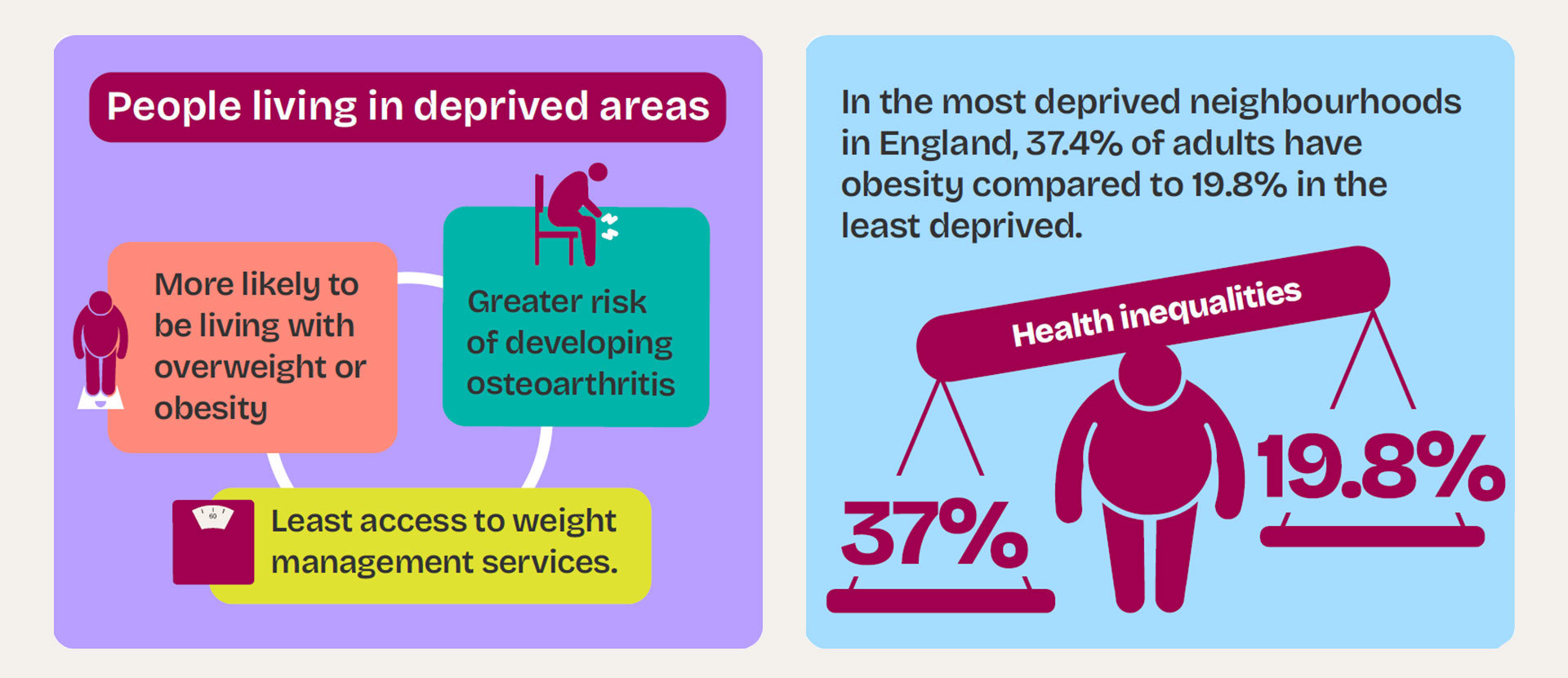
Inconsistent eligibility criteria disproportionately affect deprived areas, where osteoarthritis is more prevalent. Higher rates of obesity in these areas also account for around a 50% extra risk of knee osteoarthritis. Yet access to weight management services is limited.
As a result, patients in deprived areas are the most disadvantaged in accessing the support needed to qualify for surgery, entrenching injustice and widening inequalities.
When waiting becomes harmful
For people with arthritis, every delay in surgery is avoidable suffering, prolonging pain and joint deterioration.
“Being denied [a] knee operation for being overweight only made things worse because of problems getting around so you end up putting on even more weight”
For many, waiting for treatment means stepping back from employment, relationships and activities that give life meaning. Arthritis UK’s Left Waiting, Left Behind survey found that 68% of respondents said that waiting for treatment had impacted their ability to work and 73% said that it impacted their social activities. People with arthritis should not have to put their lives on hold to meet arbitrary eligibility thresholds.
Arthritis UK calls on ICBs to scrap BMI threshold policies used to ration surgeries
Our key recommendations:
- BMI threshold policies where applied should not be used to ration access to joint replacement surgery and instead should be based on individual clinical need.
- ICBs should adhere to NICE Osteoarthritis guidelines.
- ICBs and local authorities should ensure weight management services are available and made accessible. These services should continue to be offered after surgery and not solely for the purpose of surgery.
We’re here whenever you need us
Arthritis UK is here to support anybody impacted by these policies. We provide guidance, advice and services. If you would like to talk to someone, remember you can:
- Call our free helpline on 0800 5200 520.
- Chat with our Arthritis Virtual Assistant (AVA).
- Join our online community.
- Stay in touch and follow us on X (Twitter), Facebook and Instagram.
- Call our helpline 0800 5200 520 for free today (Monday–Friday, 9am–6pm). Our advisors offer advice about arthritis tailored to you.
If this is something that has affected you, and you are willing to share your story, we would like to hear from you. Please contact the Policy team: Policy@arthritis-uk.org